


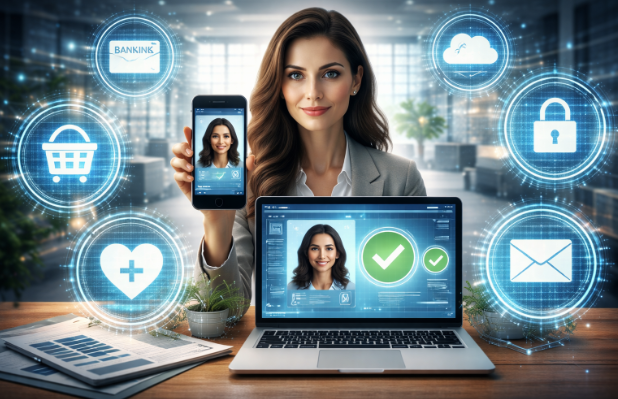
Think about how many online accounts you have. Your bank, your investment platform, your health app, your streaming service, your pension provider, your mortgage portal. Every one of them holds personal and financial data that has real, tangible value, and every one of them is a potential target for someone trying to steal your identity.
The scale of the problem is difficult to overstate. According to Javelin Strategy and Research, identity fraud losses in the United States exceeded $52 billion in 2023 alone. In the United Kingdom, Action Fraud logged over 350,000 identity crime reports in the same year. These are not abstract statistics. Behind every figure is a real person who spent months, sometimes years, untangling the financial and legal consequences of having their identity stolen.
The digital economy has made life more convenient in countless ways. It has also made it considerably easier for criminals to exploit the gap between the information a person provides online and the ability of a business to confirm that information is genuine. Closing that gap is the purpose of modern identity verification technology.
What Identity Verification Actually Does
Most people encounter identity verification at moments of low engagement, uploading a passport to open a bank account, submitting a driving licence to activate a trading platform, or scanning a face to verify age. It can feel like an administrative formality. In reality, it is a sophisticated multi-layer security process happening in seconds behind the scenes.
Document verification is the first step. When you photograph your identity document, artificial intelligence analyses its security features, holograms, microprinting, watermarks, and machine-readable zones against the expected template for that document type and country of issue. Forgeries are caught not by replicating the human expertise of a trained document officer, but by applying machine learning models trained on hundreds of millions of genuine and fraudulent documents, operating with a consistency and speed no human reviewer could match.
Biometric matching is the second step. Your selfie or short video is compared against the photograph on your submitted document using facial recognition technology. The system is not simply looking for a resemblance; it is analysing dozens of geometric data points, the distance between your eyes, the shape of your jawline, and the proportions of your face to establish a high-confidence match.
Liveness detection is the third step, and increasingly the most important. As fraud techniques have become more sophisticated, with criminals now using printed photographs, pre-recorded videos, and increasingly AI-generated deepfake faces to defeat biometric systems, liveness detection has evolved to confirm that the person completing the verification is physically present and real. Platforms certified to iBeta Level 1 and Level 2 standards perform this check using passive signals: micro-movements, depth perception, and texture analysis that a static image or AI-generated face cannot replicate.
Together, these three steps create a chain of identity assurance that is far more reliable than any password, security question, or knowledge-based authentication system ever could be.
Identity Verification in Your Everyday Financial Life
The most common place where everyday people encounter identity verification is in financial services. Opening a bank account, applying for a loan, registering with an investment platform, setting up a cryptocurrency wallet, every one of these interactions now requires verified identity, and for very good reason.
Financial crime regulators worldwide require financial institutions to know exactly who their customers are before offering services. The Financial Action Task Force, the global standard-setting body for anti-money laundering, mandates that all financial institutions implement Know Your Customer procedures. In the UK, the Money Laundering Regulations 2017 require every regulated firm to verify customer identities using reliable and independent documentation. In the US, FinCEN’s Customer Identification Programme rules apply across the entire banking sector.
For consumers, this means that the identity verification process you complete when opening a new account is not a bureaucratic inconvenience; it is the mechanism that prevents someone else from opening an account in your name, taking out credit in your name, or laundering money through an account fraudulently registered to your identity.
Platforms that have invested in genuinely robust verification are the ones best equipped to protect the customers they serve. When a neobank can confirm that you are who you say you are within 30 seconds, using AI and biometrics rather than a slow postal process, it is not just faster, it is more secure.
The Rise of eKYC and What It Means for You
A significant shift has been underway in how identity verification software is delivered. For most of financial history, verifying identity required physical presence, visiting a branch, posting certified copies, and attending an appointment. The emergence of eKYC (electronic Know Your Customer) has changed this entirely.
eKYC is the process of completing full identity verification entirely digitally, no post, no branch visit, no paper forms. Using a smartphone or computer, customers can submit their identity documents, complete a biometric face check, and receive a verified status within a minute. For regulated businesses, eKYC platforms provide the same level of compliance assurance as traditional in-person verification, often with higher accuracy and a complete, tamper-proof audit trail.
The practical implications for everyday life are substantial. It means you can open a bank account on a Sunday afternoon, apply for a loan at midnight, or set up a trading account during your lunch break without ever visiting a physical location. For people in rural areas, those with mobility limitations, or individuals accessing services from abroad, eKYC has removed barriers that previously excluded them from the formal financial system entirely.
Identity Fraud: How It Happens and Why AI Verification Stops It
Understanding how identity fraud occurs makes it much easier to appreciate why robust verification matters. Criminals acquire personal information through data breaches, phishing attacks, social engineering, and dark web marketplaces where stolen identity data is sold in bulk. Armed with a name, date of birth, address, and national identification number, a fraudster can attempt to open financial accounts, take out credit, claim benefits, or commit crimes under someone else’s identity.
Traditional verification methods, checking a name and address against a credit reference database, for example, are particularly vulnerable to this type of attack, because the fraudster possesses exactly the information the system is checking for. AI-powered verification with biometric matching changes the equation fundamentally. Even if a criminal has someone’s complete identity data, they cannot replicate that person’s face, and they cannot produce a genuine, unmanipulated version of their physical identity document.
Synthetic identity fraud, where criminals construct entirely new identities by combining real elements (such as a genuine national insurance number) with fabricated details, has become one of the fastest-growing fraud categories globally, accounting for up to 80% of all identity fraud losses at some financial institutions. This fraud type specifically targets verification systems that rely on data matching alone. Biometric verification, combined with document authentication, is the primary defence against it.
Protecting Your Digital Identity: What Individuals Should Know
As a user of digital services, there are practical steps that awareness of identity verification can inform. When a platform asks you to verify your identity, the quality of that verification process is a signal about the seriousness with which the platform takes security. A platform that completes verification instantly with no document or biometric check is one that offers correspondingly less protection against fraudulent account creation.
Look for platforms that use certified biometric verification. iBeta Level 1 and Level 2 certification for liveness detection is the recognised industry standard. Look for platforms that are explicit about data handling, reputable verification providers operate under GDPR and equivalent data protection laws, encrypting your identity data and retaining it only for the period required by regulation. Look for platforms that notify you of verification events, so you know immediately if someone attempts to verify an identity using your details.
The growing adoption of reusable digital identity is also worth watching. In several countries, including the UK, regulatory frameworks are being developed that would allow a person to verify their identity once with a trusted provider and then share that verified identity with multiple services, without needing to re-submit their documents each time. This represents both a significant convenience improvement and a potential security enhancement, reducing the number of times your raw identity documents are transmitted across digital channels.
Conclusion
Identity verification has become a foundational layer of the digital economy. It is the technology that allows financial services to exist online, that enables new forms of commerce and access, and that protects individuals from one of the most damaging crimes of the digital age. Understanding both what it does and why it matters puts you in a better position to make informed choices about the platforms you use and the way you manage your digital identity.
As AI-generated fraud becomes more sophisticated and regulatory requirements continue to tighten, the platforms investin