

Managing payroll has become increasingly complex as businesses scale, expand into new markets, and navigate changing workplace dynamics. To keep up, organizations are embracing smarter solutions that cut administrative work, increase visibility, and maintain compliance. Modern companies see payroll as much more than a back-office process. It is a vital component of employee satisfaction, organizational efficiency, and regulatory management. Adopting enhancements such as online payroll for businesses provides immediate benefits in terms of accuracy, transparency, and flexibility.
Efficient payroll management is not only essential for meeting internal needs but also directly affects employee trust and the business’s reputation. As remote and hybrid work become more common, real-time data access and automated compliance updates are crucial. Companies that invest in modern payroll tools report improved cost control and faster resolution of internal issues compared to those using traditional systems. Staying ahead of evolving payroll technology is critical for businesses wanting to focus more on growth and less on manual financial processes.
With many solutions now available, business leaders must carefully select and implement payroll practices that best fit their goals, workforce style, and regulatory demands. Understanding key trends such as AI automation, real-time analytics, and outsourced processing is the first step toward building a future-ready payroll operation.
Central to this modernization effort is the integration of employee self-service functions and real-time support. These advances not only reduce the burden on payroll staff but also give employees greater control and insight into their pay and benefits.
Cloud-Based Payroll Systems
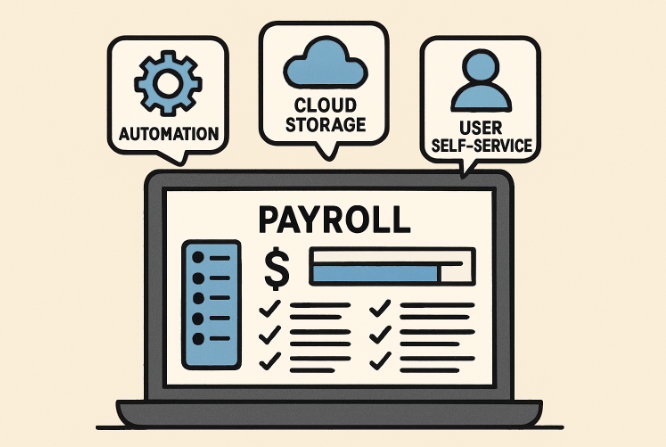
Transitioning to cloud-based payroll systems is one of the most impactful upgrades a business can make. These platforms allow payroll administrators to securely access and monitor data from virtually anywhere, making it easier to handle multi-location workforces or remote employees. Cloud solutions also support seamless updates and technical maintenance without business disruption. Cloud computing continues to drive IT investment, especially as organizations seek scalable, cost-effective tools.
AI and Automation in Payroll
AI and automation are rapidly transforming payroll by minimizing human intervention during calculations, data entry, and compliance checks. Automated tools can flag errors, ensure timely filings, and free up HR teams to focus on strategic business support. Real-world applications include machine learning algorithms that predict and prevent mistakes, as highlighted by recent Forbes coverage of the evolving payroll landscape. Businesses that utilize automation routinely report improved accuracy and significant cost savings.
Compliance with Tax Regulations
Tax laws and labor regulations are updated frequently at the local, state, and federal levels. Keeping pace requires dedicated systems that automatically adjust calculations and notify users of any changes. Failing to accurately report payroll taxes can result in substantial fines. Modern payroll software is designed to provide proactive compliance alerts and to centralize all documentation and make it audit-ready, helping companies reduce risk and administrative overhead while staying in line with the latest laws.
Employee Self-Service Portals
One of the most appreciated advancements in payroll management is the rollout of employee self-service portals. These online dashboards empower workers to view pay stubs, tax documents, and benefit selections from any device, at any time. They can also update personal information, thereby reducing the time HR must spend processing changes. Widespread adoption of self-service portals is closely linked to higher levels of employee satisfaction and lower HR administrative costs.
Outsourcing Payroll Services
Some businesses, particularly those with smaller HR departments or those operating in multiple regulatory environments, choose to outsource payroll processing to service providers. Outsourcing offers advantages such as specialized expertise, reliable technology upgrades, and assurance of compliance. For companies experiencing rapid growth, partnering with an external provider allows for scalable payroll management without straining in-house resources. It is a strategic solution for organizations seeking both efficiency and peace of mind.
Real-Time Payroll Analytics
Payroll analytics provide organizations with a comprehensive view of their workforce expenses, trends, and cash flow. Real-time data dashboards track overtime, benefits utilization, and labor costs by project or department. These insights support more accurate budgeting and enable managers to respond quickly to emerging patterns or compliance risks. A growing number of payroll platforms now offer built-in analytics tools, reflecting the drive toward more informed decision-making at every level of the business.
On-Demand Pay Options
On-demand pay, often referred to as earned wage access, is soon to become a standard benefit in many industries. This option lets employees receive a portion of their wages before the scheduled payday, helping to foster financial wellness and engagement. Companies report higher retention and improved recruitment outcomes as a result of providing such flexibility. Recent analyses show that on-demand pay is reshaping how people interact with employers and manage their earnings.
Conclusion
Businesses of all sizes are reimagining payroll as a strategic asset rather than a mere obligation. By migrating to flexible cloud-based systems, leveraging automation and real-time analytics, and providing user-friendly experiences such as employee self-service and on-demand pay, organizations can reduce risk, control costs, and compete for top talent. Modern payroll practices set the stage for productive, compliant, and employee-focused workplaces that thrive in today’s rapidly changing environment.