


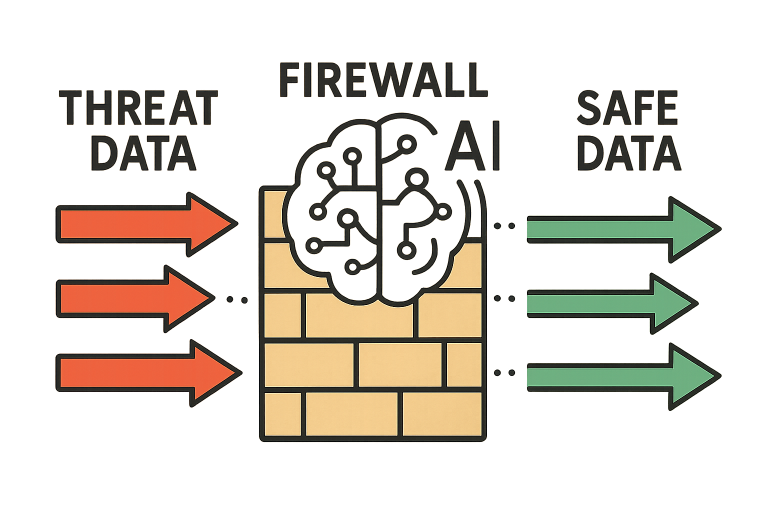
As organizations embrace digital transformation and shift to the cloud, the threat landscape is becoming more complex. Hackers routinely employ sophisticated techniques designed to bypass traditional security tools. In this environment, many security professionals are turning to AI-driven firewalls that offer continuous learning and rapid response. Unlike static security tools, these intelligent systems provide adaptive protection that changes as new threats are discovered, making them an essential part of modern cyber defense strategies.
The adoption of next generation firewalls (NGFW) is fueling this shift. These advanced firewalls combine deep packet inspection and application-level controls with AI and machine learning, transforming standard network security into a proactive, context-aware shield. By leveraging AI, next-generation firewalls can detect unknown attacks, analyze network behavior, and update their rules autonomously.
As these systems evolve, businesses must weigh not only their defensive capabilities but also how easily they can integrate into existing environments without disrupting operations. The rapid pace of threat development now demands solutions that can adapt in real time without relying solely on human intervention.
The transition towards AI-driven cybersecurity solutions is being accelerated by the need for timely, insightful threat detection that goes beyond signature-based rules. Security analysts benefit as well. These tools reduce alert fatigue by filtering out noise and highlighting genuine threats, allowing teams to focus their efforts where they matter most.
Preemptive cybersecurity technologies, including AI-driven solutions, are projected to account for over 50% of IT security spending by 2030, underscoring the urgency for organizations to adapt or risk falling behind.
Limitations of Traditional Firewalls
Traditional firewalls were built around static policies that block or permit traffic based on pre-configured rules and known attack signatures. While they were effective in early internet environments, today’s advanced threats outpace their detection capabilities. Attackers now employ polymorphic malware, zero-day exploits, and obfuscation tactics that simply slip past these conventional defenses.
Because rules are slow to update, static firewalls often miss emerging threats. Their reliance on known patterns leads to increased false positives (blocking legitimate traffic) and false negatives (missing actual intrusions). Over time, this contributes to alert fatigue and places an unnecessary burden on security teams.
In modern cloud and hybrid infrastructures, traditional firewalls also struggle with scalability and visibility. They may lack insight into encrypted traffic or non-standard ports, limiting their effectiveness as organizations expand their environments.
This gap has accelerated the industry’s shift to more dynamic, automated defenses that leverage intelligence and context rather than rigid perimeters. Traditional firewalls are quickly becoming obsolete amid the adoption of cloud and the proliferation of IoT.
The Rise of AI in Cybersecurity
Artificial intelligence has transformed the cybersecurity industry by enabling automation, pattern recognition, and rapid anomaly detection. AI-powered engines process millions of data points per second, identifying subtle shifts in behavior that might indicate a breach. Unlike signature-based detection that can only catch known threats, AI thrives on the unknown.
Machine learning models continually refine their decision-making by learning from new traffic, malicious behavior, and threat intelligence feeds. This self-improving cycle ensures that AI-driven firewalls remain effective as attackers adapt and innovate.
A significant benefit is reduced response times. AI algorithms act faster than humans can, blocking suspicious connections or isolating compromised endpoints at machine speed. This level of automation is vital as attackers now use AI to orchestrate more complex attacks, raising the stakes for defensive technologies.
The result is a more resilient, scalable, and responsive digital perimeter. Businesses gain improved security outcomes and enhanced protection for critical data assets in the era of remote connectivity and multidomain networks.
How AI-Driven Firewalls Work
AI-driven firewalls monitor network traffic in real time, processing metadata and payloads using sophisticated machine learning algorithms. These systems compare new data against baselines of normal user and application behavior to uncover deviations that may signify a threat.
By leveraging both supervised and unsupervised learning methods, these firewalls can classify traffic, spot unusual actions, and detect threats that have never been seen before. When an anomaly is detected, the firewall can automatically implement mitigation measures, such as blocking access, quarantining suspicious files, or alerting security teams.
Some next-generation solutions also correlate findings across distributed sensors and integrate with threat intelligence platforms to enrich context. This collaborative approach speeds up investigation and reduces the likelihood of false alarms.
The end result is a living security solution, one that continuously evolves, adapts, and improves, offering constant coverage regardless of how the threat landscape shifts.
Benefits of AI-Driven Firewalls
- Real-Time Threat Detection: AI algorithms analyze traffic and user behavior in real time, preventing harmful activity before significant damage occurs.
- Reduced False Positives: By understanding what normal activity looks like, these systems dramatically decrease noisy, irrelevant alerts.
- Scalability: AI-driven solutions can protect complex, distributed network environments without degrading performance, making them ideal for large enterprises and cloud-native applications.
- Improved Response: Automation enables an instant response to threats, often neutralizing them before human teams can intervene.
- Continuous Learning: Machine learning models evolve with new data, enabling firewalls to stay ahead of novel attacks.
Real-World Applications
Organizations across sectors are embracing AI-driven firewalls to bolster their security posture. For example, Cisco’s AI Assistant for Security integrates cutting-edge AI across its Security Cloud, providing sophisticated threat detection and improved operational agility. This advancement is particularly impactful for large organizations managing vast amounts of data and traffic.
Financial institutions, healthcare organizations, and cloud service providers are among those leveraging these defenses. For example, AI-driven firewalls are being used to detect fraudulent financial transactions, stop ransomware attacks in healthcare environments, and prevent data exfiltration in cloud deployments.
These technologies are also critical for regulatory compliance by helping organizations monitor, document, and report suspicious activities, enabling them to meet stringent requirements such as GDPR and HIPAA.
Challenges and Considerations
Despite their promise, AI-driven firewalls are not without hurdles. These include the need for ongoing model training and data quality assurance to ensure accuracy and reduce the risk of adversarial manipulation. Integrating AI with legacy infrastructure can require careful planning and additional investment.
Another consideration is transparency. As AI models become more complex, it can be challenging for security teams to understand how decisions are made, raising questions about accountability, especially in regulated industries.
There is also the challenge of maintaining ethical standards in AI use. Security leaders must consider data privacy, bias avoidance, and the potential for unintended consequences as automated systems assume greater responsibility for decision-making.
Ultimately, while AI-driven firewalls represent a leap forward, they function best as part of a multi-layered security approach that combines intelligent automation with human expertise and traditional controls.
Conclusion
As cyber threats grow more sophisticated and relentless, AI-driven firewalls are quickly becoming indispensable tools in defending digital assets. Their ability to analyze massive streams of data, adapt in real-time, and automate protective responses places them at the heart of future-ready security strategies. Organizations looking to safeguard their infrastructures must evaluate how these intelligent solutions can fit into their operations, ensuring they balance advanced technology with careful oversight and expert human input.